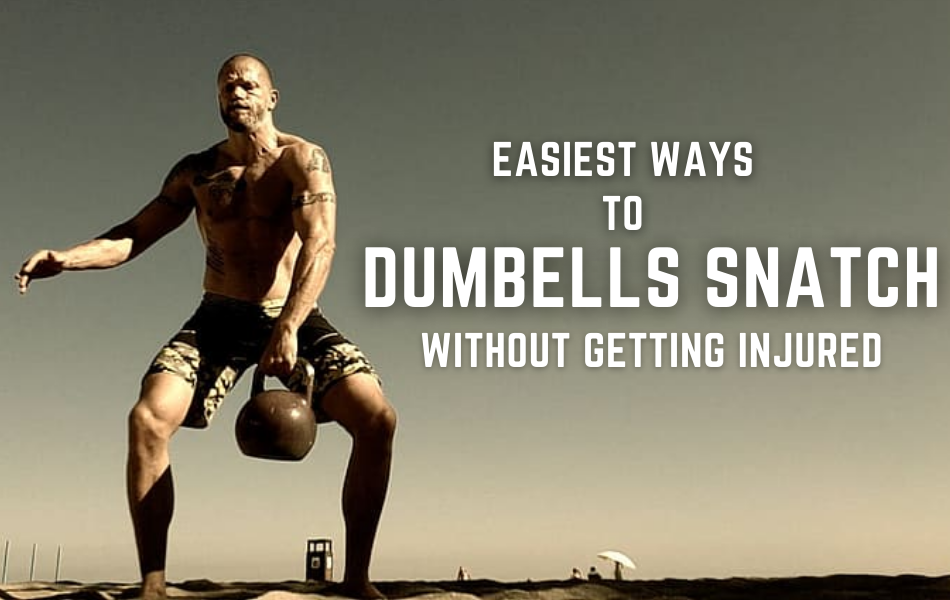

Keep the weight close:
Don’t let the dumbbell swing wide ahead of your body then initial deadlift hip-pop. That’s a waste of energy (not to say tons of stress on your shoulder).
Keep the momentum going vertically as aggressively as possible by beginning to pull the dumbbell upwards.

Keep it on the brink of your body as if zipping up a coat. consider pulling it on the brink of your body the entire time, then, once it nears shoulder height, consider pulling it toward your chest.
Punch up:
Once you’ve pulled it toward your chest, quickly consider punching the dumbbell upwards. Again, don’t make this a shoulder motion, though. Consider sliding your torso underneath the dumbbell, then driving up together with your legs.
You ought to never feel the dumbbell snatch (or any snatch) intensely in your shoulders. this is often a lower-body power move.
Tight Core:
Don’t fall under the trap of coaching insanely heavy for top reps when doing dumbbell snatches. Yes, this will easily be programmed as a move in some kind of metabolic conditioning routine.

But as you fatigue, your form is destined to fail, and there are numerous moving parts that the failure won’t be pretty.
So cap the load to guard yourself. A sensible start is keeping it to a weight that you simply can shoulder press, that way, once you start to believe your shoulders more, they’re able to handle the load.

Benefits of Dumbbell snatch:
The dumbbell snatch may be a unilateral exercise, meaning that you simply specialize in one side of the body at a time.
Unilateral movements are excellent for reducing side-to-side muscle imbalances that exist in many of us while helping athletes improve performance in areas that will translate on to the court, field, or mat.
Increased Muscle Balance and Coordination:
The dumbbell snatch, like most unilateral exercises, offers lifters a chance to deal with any muscular imbalances and movement asymmetries that will otherwise go undetected when training with a barbell.
While the dumbbell snatch might not have a direct technique applied to the highly technical barbell snatch, it can still be wont to enhance shoulder stability, strength, and power for all level lifters.

Beginner-Friendly Power Exercise:
The dumbbell snatch requires less technique, mobility, and arguably less skill than the barbell snatch; which may make it an honest option for beginner lifters (of all ages) and/or individuals who may have concerns snatching overhead with a barbell (such as overhead athletes because the barbell doesn’t leave individual shoulder positioning overhead).
Both the dumbbell snatch and therefore the barbell snatch is often used and integrated within training programs;
however, the dumbbell snatch is usually an honest exercise to introduce to newer lifters in order that they will grasp a far better concept of the general movement patterning.
Versatile Movement for Conditioning Workouts:
Like the kettlebell, the dumbbell allows lifters to perform longer (time duration) sets and complexes (yes, the barbell can be effective at this as well).
The dumbbell snatch, when done in a cyclical motion, can be performed for longer durations, and often seamlessly transitioned into other dumbbell exercises like windmills, presses, goblet squats, swings, etc; further increasing metabolic demands.

Who should do Dumbbell snatches?
Below are some reasons why strength, power, and fitness athletes can benefit from performing the dumbbell snatch.
Powerlifters and Strongman:
The dumbbell snatch is often trained to extend overall fitness and used as a way for metabolic conditioning/work capacity training.
Additionally, the dumbbell snatch is often done to include more ballistic and explosive-based lifting within training programs to further enhance strength development and force production (rate of force production).
While the snatch movement isn’t specific to the bench press, squat, deadlift, or most other movements wiped out most strongman events, it can help to enhance overall strength and athletic development.
Olympic Weightlifters:
While the dumbbell snatch doesn’t transfer specifically to the barbell snatch, it is often used at certain times when a lifter might not be ready to snatch (let’s say thanks to a wrist injury).
The dumbbell snatch is often done to take care of basic movement patterning during times where no training would otherwise occur.
That said, adding dumbbell snatches within formal weightlifting training for other reasons, may very well limit recovery from barbell snatch sessions (done with a barbell).
Functional Fitness Athletes:
The dumbbell snatch may be a useful exercise within the training of functional fitness and Cross-Fit athletes looking to extend overall strength, power, and fitness.
The dumbbell snatch is an exercise that has found its way into a couple of CrossFit workouts at the local, Open, Regionals, and Games level.
Failure to coach the dumbbell snatch could end in leaving overhead strength, stability, and sport-specific improvements on the table.

Hip dips occur where the skin is tethered, or attached, to the deeper part of your thigh bone. This is due to the amount and distribution of fat and muscle in your body structure.
If you want to minimize the appearance of hips dips, you can do certain exercises. They can help you build muscle and lose fat.

Leave a Reply
You must be logged in to post a comment.